
Myeloma Genomics and Microenvironment and immune profiling
Category: Myeloma Genomics and Microenvironment and immune profiling
Integrated multi-omic profiling of immune, soluble, and microbial signatures identifies predictors of multiple myeloma evolution

Anna Maria Corsale (she/her/hers)
Post-doctoral Researcher
University of Palermo, Department of Health Promotion, Mother and Child Care, Internal Medicine and Medical Specialties (ProMISE), Palermo, Italy.
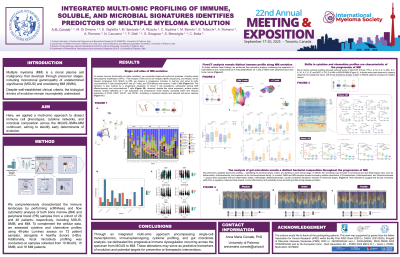
scRNAseq analysis revealed a progressive upregulation of immune checkpoint-related genes, including CD266, TIGIT, and members of the KIR family, accompanied by a concomitant downregulation of CD96 expression during MM evolution. In parallel, flow cytometric profiling indicated a significant depletion of PB transitional memory CD8⁺ T cells in MM patients, accompanied by an increase in both PB and BM TEMRA CD57⁻ CD8⁺ T cells, compared to MGUS and SMM. The evaluation of cytokine and chemokine levels revealed a marked reduction of multiple immune mediators (including GM-CSF, IFN-α2, IFN-γ, IL-1β, IL-2, IL-2Rα, IL-3, IL-10, IL-13, LIF, and MCP-1/CCL2) in BM plasma of MM patients compared to MGUS, SMM, and HDs, indicating impaired T cell activation, reduced immune cell recruitment, and an overall immunosuppressive milieu. A similar profile of immune mediator reduction was observed in PB plasma. Notably, this immune dysfunction is detectable not only in MM but also in MGUS and SMM patients, when compared to HDs. Complementary gut microbiota profiling identified a shift towards dysbiosis in MM patients, characterized by expansion of pro-inflammatory taxa (Proteobacteria, Enterobacteriaceae, Streptococcaceae) and depletion of beneficial microbial families (e.g., Lachnospiraceae, Bifidobacteriaceae). Notably, microbiota composition correlated with disease stage: MGUS samples retained a eubiotic profile, while SMM showed an intermediate state, mirroring the immune alterations observed in systemic compartments.
Conclusions:
Through an integrated multi-omic approach encompassing single-cell transcriptomics, immunophenotyping, cytokine profiling, and gut microbiota analysis, we delineated the progressive immune dysregulation occurring across the spectrum from MGUS to MM. These alterations may serve as predictive biomarkers of evolution and potential targets for preventive or therapeutic interventions.