
MRD and Biomarkers
Category: MRD and Biomarkers
Integrating p53 Protein Expression with Mutation and Copy Number Status Enhances Risk Assessment in Myeloma

Pei Lin, MD (she/her/hers)
Professor
UT MD Anderson Cancer Center
Deletion of (17p) in ≥20 % neoplastic cells or TP53 mutation (TP53mut) regardless of VAF level are defined as high-risk factors in the newly proposed IMS/IMWG model. It remains unclear if the risk can be further stratified based on the scale and context of these alterations. We hypothesized that further assessment of p53 protein expression may allow an integrated risk assessment. In wild type TP53, p53 expression by immunostaining is weak and heterogenous while mutations or deletions typically result in abnormal p53 expression as overexpression (HI) or total absence (Null).
Methods:
The TP53 copy number changes, del17/(17p), were determined by conventional karyotyping and/or fluorescence in situ hybridization (FISH) using CD138 enriched plasma cells. TP53mut was detected by targeted next generation sequencing (NGS) using whole bone marrow aspirate. Bone marrow trephine samples were stained using a monoclonal anti-p53 antibody clone DO-7 (Dako, Carpinteria, CA) which recognizes both wild-type and the mutant forms. Clinical data were collected from chart review.
Results:
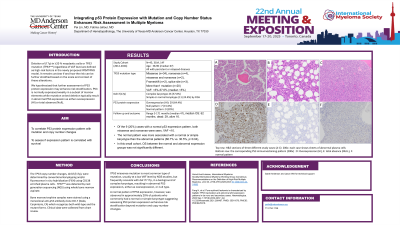
The study included 45 patients with adequate samples and documented TP53 mutations collected from 2012-2024. There were 31 men and 14 women, age 38 to 90 (median: 67yrs). All patients had persistent or relapsed diseases. In 20 patients, >1 TP53 mutations were detected. The mutations were characterized as missense (n=34), nonsense (n=4), both missense and nonsense (n=2), frameshift (n=2), splice site (n=3). The VAF levels ranged from < 5% to 57.6% (median < 5%), despite a much higher tumur burden (median: 60%, range 10-100%) determined by CD138 staining. Del17/(17p) was detected in a background of complex karyotype in 17 of 26 (65.4%) patients with a complex karyotype (57.8%), or by FISH in a background of a simple or normal karyotype in 11 (24.4%). A p53 overexpression (HI) or a null pattern were seen in 29 (64.4%) and 7 (15.6%) respectively. Of the 9 (20%) cases with a normal p53 pattern, both missense and nonsense were seen, VAF < 10. With a median follow up of 47 month (range 3-171), 29 died and 16 were alive with a median OS of 62 months. The normal pattern was more associated with a normal or simple karyotype than the abnormal pattern (66.7% vs. 30.5%, p=0.04), though in this small cohort, the OS between the normal and abnormal expression groups was not significantly different.
Conclusions:
TP53 missense mutation is most common type of mutation, usually present at a low VAF, and frequently coexists with del17/17p, in a background of complex karyotype, resulting in abnormal p53 expression. A normal pattern of p53 expression, however, was observed in approximately 20% of patients who are more likely to have a normal or simple karyotype, compared to patients with abnormal p53 expression, suggesting that integrating p53 protein expression may enhance risk stratification beyond mutation and copy number changes.