
MRD and Biomarkers
Category: MRD and Biomarkers
The Role of CHIP Mutations in Plasma Cell Dyscrasias: Implications for Clonal Evolution and Risk Stratification

Kristin Ezell, MD
Resident Physician
University of Connecticut
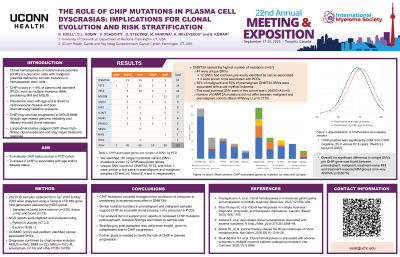
We identified 161 mutations across 12 CHIP-associated genes. DNMT3A carried the highest number of mutations (n=57), 44 of which were unique single nucleotide variants (SNV). 12 SNVs had not been previously identified as cancer-associated, and only 3 were known to be associated with PCDs. 58% of malignant and 50% of premalignant DNMT3A SNVs were associated with acute myeloid leukemia. The most common SNV seen in this cohort was c.2645G >A (n=4). Number of DNMT3A mutations did not differ between malignant and premalignant cohorts (Mann-Whitney U, p=0.7715). CHIP-positive was older than CHIP-negative in the overall cohort (70.8 versus 67.4 years; Welch’s t-test, p=0.0002), and distribution curves highlight this shift. Unique SNV counts for DNMT3A, TET2, and ASXL1 were similar or the same in premalignant and malignant samples (22 and 24, 10 and 9, 4 and 4, respectively). Overall, no significant difference in unique SNVs per CHIP gene was found between premalignant, malignant, treatment-naive MM, and treatment-exposed MM groups (one-way ANOVA, p=0.6079).
Conclusions: CHIP mutations occurred across all disease states, most often in DNMT3A. Similar mutation burdens in premalignant and malignant samples support CHIP as a parallel clonal process, not a precursor. Our analysis did not support prior reports of increased CHIP mutations post-treatment; however, it is limited by a sample size. Stratifying by post-ASCT may yield more insight, given its role as a potential contributor to disease complexity and resistance. Further study is needed to clarify the role of CHIP in disease progression.