
Nursing and Allied Health Symposium
Category: Nursing & Allied Health Symposium
Enhancing Patient Education and Support in Multiple Myeloma: A Toolkit-Based Nursing Intervention
Carrie L. Bellerive, BS, RN, BMTCN
Clinical Nurse Coordinator, Cellular Therapy Service
Memorial Sloan Kettering Cancer Center
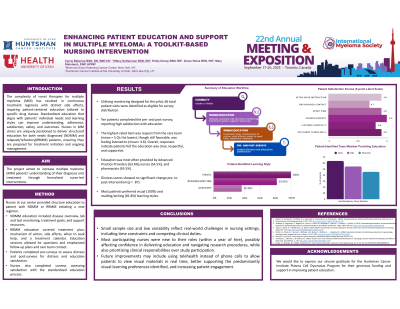
Nurses at our center provided structured education to patients with NDMM or RRMM initiating a new regimen. NDMM education included disease overview, lab and test monitoring, treatment goals, and support resources. RRMM education covered treatment plan, mechanism of action, side effects, when to seek help, and a treatment calendar. Education sessions allowed for
questions and emphasized follow-up plans and care team contact. Patients completed pre-surveys to assess distress and post-surveys for distress and education satisfaction. Nurses also completed surveys assessing satisfaction with the standardized education process.
Results: Utilizing monitoring designed for this pilot, 66 total patient visits were identified as eligible for survey distribution. Ten patients completed the pre- and post-survey, reporting high satisfaction with education. The highest-rated item was respect from the care team (mean = 5.0); the lowest, though still favorable, was feeling listened to (mean = 4.8). Overall, responses indicate patients felt the education was clear, respectful, and supportive. Education was most often provided by Advanced Practice Providers (63.6%), nurses (54.5%), and pharmacists (45.5%). Distress scores showed no significant change pre- to post-intervention (p = .87). Most patients preferred visual (100%) and reading/writing (81.8%) learning styles. Nurse feedback showed stable satisfaction over time.
Conclusions: Small sample size and low variability reflect real-world challenges in nursing settings, including time constraints and competing clinical duties. Most participating nurses were new to their roles (within a year of hire), possibly affecting confidence in delivering education and navigating research procedures, while also prioritizing clinical responsibilities over study participation. Despite this, the program was well received. Future improvements may include using telehealth instead of phone calls to allow patients to view visual materials in real time, better supporting the predominantly visual learning preferences identified, and increasing patient engagement.