
Treatment of Relapsed/Refractory Myeloma (excluding T-cell redirection therapy)
Category: Treatment of Relapsed/Refractory Myeloma (excluding T-cell redirection therapy)
CYP3A4 modulators do not affect the pharmacokinetics of selinexor

David Ray, PharmD, MBA, MPH
Executive Director, Global HEOR
Karyopharm Therapeutics
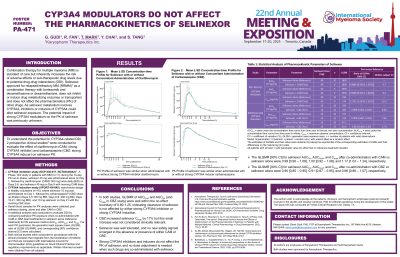
The CYP3A4 inhibition study was nested in the Phase 1b/2 study KCP-330-017 (NCT02343042) in adult patients with MM (n=11) with a 14-day PK run-in phase. Patients received selinexor 40 mg alone on day 1, CAM 500 mg twice-daily (BID) on days 2-8, and selinexor 40 mg on day 8 with the morning CAM dose. The CYP3A4 induction study (XPORT-HV-045) was a stand-alone design in healthy adult volunteers (n=16). Selinexor 10 mg was administered on day 1, followed by CBZ dose up-titration (days 3-5:100 mg BID, days 6-9: 200 mg BID, days 10-21: 300 mg BID) and 10 mg selinexor on day 21 with the morning CBZ dose. Serial blood samples for PK analyses were collected post selinexor dosing, alone and after CAM or CBZ. A statistical analysis was conducted to evaluate DDI by comparing selinexor PK exposure when co-administered with CAM or CBZ (test treatments) to selinexor alone (reference treatment) for PK exposure metrics AUC0-t, AUC0-inf, and Cmax. The geometric least square mean (GLSM), ratio of GLSM (GLSMR), and corresponding 90% confidence interval (CI) were calculated for each PK parameter.
Results:
The GLSMR (90% CI) for selinexor AUC0-t, AUC0-inf, and Cmax after co-administration with CAM vs selinexor alone was 0.99 (0.90, 1.08), 1.00 (0.92, 1.08), and 1.17 (1.03, 1.34), respectively. The GLSMR (90% CI) for selinexor AUC0-t, AUC0-inf, and Cmax after co-administration with CBZ vs selinexor alone was 0.90 (0.85, 0.95), 0.91 (0.87, 0.95), and 0.96 (0.86, 1.07), respectively.
Conclusions:
In both studies, GLSMR of AUC0-inf and AUC0-t (and Cmax in CBZ study) were within the no effect boundary of 0.80-1.25, indicating clearance of selinexor is not affected by either strong CYP3A4 inhibition or strong CYP3A4 induction. CAM increased selinexor Cmax 17% but this small increase is not considered clinically relevant. Selinexor was well tolerated, and no new safety signals emerged in the absence or presence of CAM or CBZ. Strong CYP3A4 inhibitors and inducers do not affect the PK of selinexor, and no dose adjustment is needed when such drugs are co-administered with selinexor.