
Imaging, QoL and Patient-Reported Outcome and Supportive Care
Category: Imaging, QoL and Patient-Reported Outcome and Supportive Care
Denosumab-Related Osteonecrosis of the Jaw in Patients with Multiple Myeloma: A Chinese Single-Center Retrospective Cohort Study
.jpg "Bin Chu photo")
Bin Chu
Associate Chief Physician
Beijing Jishuitan Hospital, Capital Medical University
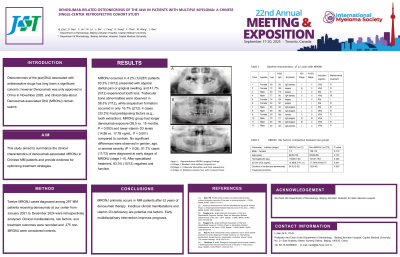
Denosumab, an antiresorptive agent that inhibits osteoclast activity, was approved for osteoporosis treatment (60 mg/6 months) in 2010 and for bone metastases or multiple myeloma (MM) (120 mg/4 weeks) in 2011 to delay or reduce skeletal-related events. A critical adverse effect during long-term use is medication-related osteonecrosis of the jaw (MRONJ), with an incidence of approximately 4%, making it the most common adverse event leading to treatment discontinuation. MRONJ causes severe pain, bone exposure, and infection, significantly impairing quality of life. However, its insidious early symptoms often lead to delayed diagnosis. Denosumab was only approved in China in November 2020, and clinical data remain scarce. This study aimed to characterize denosumab-associated MRONJ in Chinese MM patients and optimize treatment strategies.
Twelve MRONJ cases diagnosed among 287 MM patients receiving denosumab at our center from January 2021 to December 2024 were retrospectively analyzed. Clinical manifestations, imaging findings, risk factors, and treatment outcomes were compared with 275 non-MRONJ controls.
Incidence: MRONJ occurred in 4.2% (12/287), with a median denosumab treatment duration of 26.5 months (range: 12–32). Clinical Presentation: 83.3% (10/12) presented with atypical dental pain or gingival swelling, and 41.7% (5/12) experienced tooth loss. Imaging: Trabecular bone abnormalities were observed in 58.3% (7/12), while sequestrum formation occurred in only 16.7% (2/12). Local Triggers: 4 cases (33.3%) had predisposing factors (e.g., tooth extraction). Risk Factors: MRONJ patients had longer denosumab exposure (26.5 vs. 15 months, P = 0.003) and lower vitamin D3 levels (14.88 vs. 17.78 ng/mL, P = 0.001) compared to controls. No significant differences were observed in gender, age, or anemia severity (P > 0.05). Treatment Outcomes: 91.7% (11/12) were diagnosed at early stages (I–II). After specialized treatment, 83.3% (10/12) regained oral function.
MRONJ primarily occurs in MM patients after ≥2 years of denosumab therapy. Insidious clinical manifestations and vitamin D3 deficiency are potential risk factors. Early multidisciplinary intervention improves prognosis.