
Treatment of Relapsed/Refractory Myeloma (excluding T-cell redirection therapy)
Category: Treatment of Relapsed/Refractory Myeloma (excluding T-cell redirection therapy)
Real-World Management of Relapsed/Refractory Multiple Myeloma Following Early Anti-CD38 Exposure

Esther Ortega, MD (she/her/hers)
Hematology consultant at Jerez de la Frontera Hospital
Hospital Universitario Jerez de la Frontera
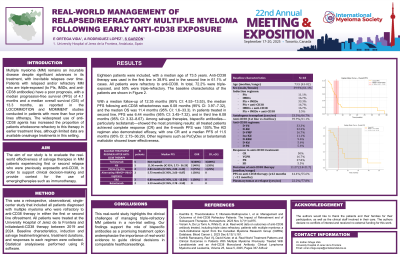
This was a retrospective, observational, single-center study that included all patients diagnosed with multiple myeloma who were refractory to anti-CD38 therapy in either the first or second line of treatment. All patients were treated at the University Hospital of Jerez de la Frontera and initiated anti-CD38 therapy between 2019 and 2024. Baseline characteristics, induction and salvage treatment regimens, treatment durations, and responses to each regimen were collected. Statistical analysis was performed using R software.
Results: Eighteen patients were included, with a median age of 73.5 years. Anti-CD38 therapy was used in the first line in 38.9% and in the second line in 61.1% of cases. All patients were refractory to anti-CD38. In total, 72.2% were triple-exposed, and 50% were triple-refractory.
With a median follow-up of 12.35 months (95% CI: 4.53–13.53), the median PFS following anti-CD38 refractoriness was 6.08 months (95% CI: 3.97–7.32), and the median OS was 11.4 months (95% CI: 1.6–33.3). In patients treated in second line, PFS was 6.44 months (95% CI: 3.45–7.32), and in third line 6.08 months (95% CI: 3.32–8.67). Among salvage therapies, bispecific antibodies—particularly teclistamab—showed the most promising results: all treated patients achieved complete response (CR) and the 6-month PFS was 100%. The KD regimen also demonstrated efficacy, with one CR and a median PFS of 11.5 months (95% CI: 2.73–36.29). Other regimens such as PoCyDex or belantamab mafodotin showed lower effectiveness.
Conclusions: This real-world study highlights the clinical challenges of managing triple-refractory MM patients in a non-trial setting. Our findings support the role of bispecific antibodies as a promising treatment option and emphasize the importance of real-world evidence to guide clinical decisions in comparable healthcare settings. Additional figures, survival curves, and detailed data will be presented in the final poster.