
Treatment of Relapsed/Refractory Myeloma (excluding T-cell redirection therapy)
Category: Treatment of Relapsed/Refractory Myeloma (excluding T-cell redirection therapy)
Trial in Progress: REALiTEC-2, an International Retrospective Study of Clinical Outcomes in Patients with Relapsed Refractory Multiple Myeloma Treated with Teclistamab in the Real World

Aurore Perrot, MD, PhD (she/her/hers)
Professor
University of Toulouse, University Hospital Department of Hematology, IUCT Oncopole CRCT, Toulouse, France
Teclistamab was the first approved bispecific monoclonal antibody for triple-class exposed relapsed/refractory multiple myeloma (RRMM) patients. This approval followed the promising findings from the pivotal MajesTEC-1 clinical trial, with 63% of patients responding to treatment, 73.2% of those responses being complete response or better (≥CR) and 94.3% very good partial response or better (≥VGPR)1. The first cohort of the REALiTEC study2, primarily comprising heavily pre-treated patients from pre-approval access programs, reported similar outcomes, with an overall response rate (ORR) of 60.3%, of which 86.7% were ≥VGPR. Patients who attained deep responses (≥VGPR) experienced improved duration of response (DOR), progression-free survival (PFS), and overall survival (OS), with a median DOR of 26.1 months and PFS and OS not reached (NR) after a median follow up of 20.7 months. While data from cohorts treated outside of clinical trials provide additional insights and support their findings, there is a need for up-to-date data to better understand the latest results and practices in the real-world setting.
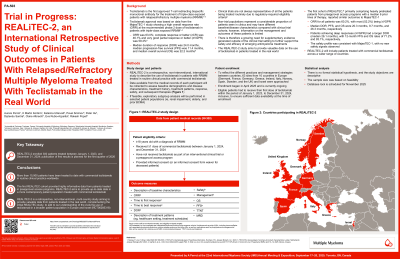
Methods: REALiTEC-2 is a retrospective, non-interventional, international study to describe the use of teclistamab in RRMM patients in routine clinical practice. Data from patients’ medical records will be collected to assess their characteristics and demography, history of prior antimyeloma treatments, treatment patterns, effectiveness (PFS, OS, response rates, DOR, time to response, time to next treatment), safety and subsequent treatments. If feasible, exploratory subgroup analysis will be performed in selected patient populations (renal impairment, elderly, prior BCMA targeted treatment). To be eligible, patients included in this study will need to have been treated with commercial teclistamab having received the first dose within the period of January 1st, 2023, to 31st of December 2024, inclusive, to ensure sufficient data availability at the time of enrolment. Based on feasibilities and considering the descriptive nature of the study, a sample size of around 400 patients has been established. To reflect the different practices and management strategies between countries, 63 sites from 11 countries in Europe and Israel were approached, and enrolment began in April 2025 and is currently ongoing.
Results: N/A
Conclusions:
More than 15900 patients have been treated to date with teclistamab in clinical practice worldwide. REALiTEC-2 aims to provide valuable data from patients treated in the real world, complementing REALiTEC´s first cohort and other ongoing observational studies, to inform about patient populations treated, outcomes and current management of teclistamab in routine clinical practice.