
Imaging, QoL and Patient-Reported Outcome and Supportive Care
Category: Imaging, QoL and Patient-Reported Outcome and Supportive Care
Dialysis-dependence is associated with poor prognosis in multiple myeloma: a multicenter retrospective cohort study

Chenyun Wang, MD
Physician
The First Affiliated Hospital of Zhejiang University, School of Medicine
Patients with multiple myeloma (MM) and renal impairment (RI), particularly those requiring dialysis, have historically experienced poor outcomes. Despite advancements in targeted therapies, the prognosis of dialysis-dependent MM and factors influencing dialysis independence remain unclear.
Methods:
This multicenter, retrospective study included 122 MM patients requiring chronic hemodialysis (≥28 days of treatment) at four tertiary hospitals, China from January 2012 to November 2023. Hemodialysis resulting from causes other than MM were excluded. Logistic regression was employed for multivariate analysis of factors associated with dialysis independence, and Kaplan-Meier survival curves and Cox proportional hazard models were utilized for survival analysis.
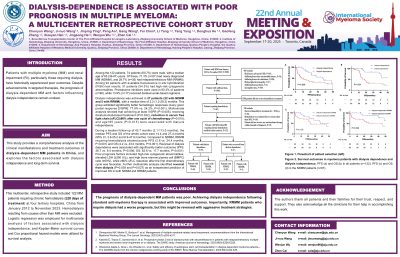
Results: Among the 122 patients, 74 patients (60.7%) were male, with a median age of 65 (39-87) years. Of these, 71.3% (n=87) had newly diagnosed MM (NDMM), and 28.7% (n=35) had relapsed/refractory MM (RRMM). Among 94 patients with available fluorescence in situ hybridization (FISH) test results, 51 patients (54.3%) had high-risk cytogenetic abnormalities. Proteasome inhibitors were used in 80.3% of patients (n=98), while 13.9% (n=17) received daratumumab-based regimens.
Dialysis independence was achieved in 27 patients (22 with NDMM and 5 with RRMM), with a median time of 2.2 (1.2-29.3) months. This group exhibited significantly better hematologic responses (≥very good partial response [VGPR]: 77.8% vs. 24.2%, P< 0.001). Multivariate analysis showed that achieving at least VGPR (P=0.005), receiving daratumumab-based treatment (P=0.032), reduction in serum free light chain (sFLC)≥80% after one cycle of chemotherapy (P=0.010), and age< 65 years (P=0.015) were associated with dialysis independence.
During a median follow-up of 43.7 months (2.1-113.0 months), the median PFS and OS of the whole cohort were 14.4 and 27.4 months (95% CI, 3.6-25.2 and 6.9-47.9 months). Compared to NDMM, RRMM requiring hemodialysis showed poorer PFS (2.6 vs. 24.4 months, P< 0.001) and OS (4.2 vs. 43.0 months, P< 0.001). Reversal of dialysis dependence were associated with significantly better outcomes (PFS: 36.7 vs. 9.4 months, P=0.006; OS: 62.6 vs. 17.7 months, P< 0.001). Poor prognosis factors included high-risk cytogenetic abnormalities, elevated LDH (≥250 U/L), and high bone marrow plasma cell (BMPC) ratio (≥50%), while ≥80% sFLC reduction after the first chemotherapy cycle was favorable. Further multivariate analysis identified reversal from dialysis (P=0.039 and P=0.027) as an independent predictor of improved OS in both NDMM and RRMM patients.
Conclusions:
The prognosis of dialysis-dependent MM patients was poor. Achieving dialysis independence following standard anti-myeloma therapy is associated with improved outcomes. Importantly, RRMM patients who require dialysis had a worse prognosis, but this might be reversed with aggressive treatment strategies.