
Imaging, QoL and Patient-Reported Outcome and Supportive Care
Category: Imaging, QoL and Patient-Reported Outcome and Supportive Care
The Optimising Outcomes in Myeloma Patients with Frailty (OOMPF) Study

Hannah L. Miller, MPharm (she/her/hers)
Lead Macmillan Pharmacist
The Christie NHS Foundation Trust
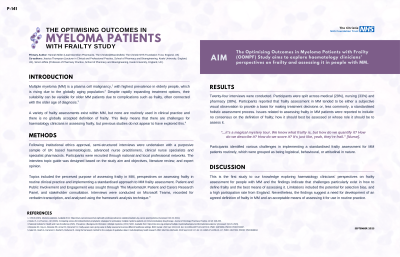
Multiple myeloma (MM) is a plasma cell malignancy, with highest prevalence in elderly people, which is rising due to the globally aging population. Despite rapidly expanding treatment options, their suitability can be variable for older MM patients due to complications such as frailty, often connected with the older age of diagnosis. A variety of frailty assessments exist within MM, but none are routinely used in clinical practice and there is no globally accepted definition of frailty. This likely means that there are challenges for haematology clinicians in assessing frailty, but previous studies do not appear to have explored this.
The OOMPF Study aims to explore haematology clinicians’ perspectives on frailty and assessing it in people with MM on active treatment.
Methods:
Following institutional ethics approval, semi-structured interviews were undertaken with a purposive sample of UK based haematologists, advanced nurse practitioners, clinical nurse specialists and specialist pharmacists. Participants were recruited through national and local professional networks. The interview topic guide was designed based on the study aims and objectives, literature review, and expert opinion. Topics included the perceived purpose of assessing frailty in MM, perspectives on assessing frailty in routine clinical practice and implementing a standardised approach to MM frailty assessment. Patient and Public Involvement and Engagement was sought through The MyelomaUK Patient and Carers Research Panel, and stakeholder consultation. Interviews were conducted on Microsoft Teams, recorded for verbatim transcription, and analysed using the framework analysis technique.
Results:
Twenty-four interviews were conducted. Participants were spilt across medical (29%), nursing (33%) and pharmacy (38%). Participants reported that frailty assessment in MM tended to be either a subjective visual observation to provide a basis for making treatment decisions or, less commonly, a standardised holistic assessment process. Issues related to assessing frailty in MM patients were reported to include: no consensus on the definition of frailty; how it should best be assessed or whose role it should be to assess it.
Participants identified various challenges in implementing a standardised frailty assessment for MM patients routinely, which were grouped as being logistical, behavioural, or attitudinal in nature.
Conclusions:
This is the first study to our knowledge exploring haematology clinicians’ perspectives on frailty assessment for people with MM and the findings indicate that challenges particularly exist in how to define frailty and the best means of assessing it. Limitations included the potential for selection bias, and a high participation rate from England. Nevertheless, the findings suggest a need for development of an agreed definition of frailty in MM and an acceptable means of assessing it for use in routine practice.