
Cellular and T cell engager Immunotherapy
Category: Cellular and T cell engager Immunotherapy
Real-World Comparison of Idecabtagene Vicleucel and Ciltacabtagene Autoleucel in Relapsed/Refractory Multiple Myeloma: A Center for International Blood & Marrow Transplantation Research (CIBMTR) Study
.jpg "Aimaz Afrough, MD (she/her/hers) photo")
Aimaz Afrough, MD (she/her/hers)
Assistant Professor
Hematologic Malignancies and Cellular Therapy Program, Simmons Comprehensive Cancer Center, University of Texas Southwestern Medical Center
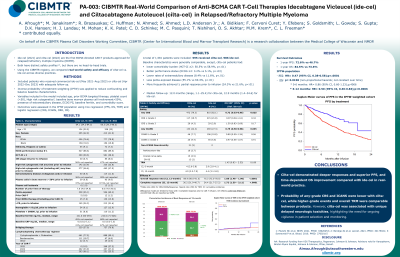
Idecabtagene vicleucel (ide-cel) and ciltacabtagene autoleucel (cilta-cel) are BCMA CAR-T products approved for relapsed/refractory multiple myeloma in 2021 and 2022, respectively, with distinct safety profiles. In the absence of head-to-head trials, we used CIBMTR data to compare their safety and efficacy in a real-world setting.
We included patients (pts) who received commercial ide-cel (May 2021–Aug 2023) or cilta-cel (Apr 2022–Dec 2023) with adequate follow-up. To reduce confounding and balance baseline characteristics, we used inverse probability of treatment weighting (IPTW) based on propensity score model. Multivariable analysis was conducted using logistic and Cox regression models.
Of 1581 pts, 595 received cilta-cel and 986 ide-cel. Baseline characteristics were generally comparable, except cilta-cel cohort had lower comorbidity burden (HCT-CI ≥2: 50.5% vs 58.9%, p< .01), better performance status (ECOG ≥2: 3.2% vs 5.1%, p=.03), fewer with extramedullary disease (8.4% vs 11.6%, p< .01), and less penta-exposed disease (55.1% vs 60.4%, p< .01), while a greater proportion achieved ≥ partial response at infusion (24.3% vs 21.6%, p< .01). Median follow-up of survivors was 12.0 months (range, 1.1–25.4) for cilta-cel, and 12.9 months (range, 1.4–34.6) for ide-cel.
Any grade CRS occurred in 79.3% vs 82.1%, and grade ≥3 in 4.3% vs 2.9% (cilta-cel vs ide-cel). Any grade ICANS was seen in 22.3% vs 27.3%, and 6-month treatment-related mortality (TRM) was 4.0% (95% CI, 2.6–5.8) vs 2.9% (95% CI, 2.0–4.1), respectively. After IPTW adjustment, cilta-cel remained associated with lower odds of any grade CRS [odds ratio (OR), 0.72, p=.0004)], and any grade ICANS (OR 0.75, p=.0005), but higher odds of grade ≥3 CRS (OR 1.50, p=.041), with no difference in grade ≥3 ICANS (OR 0.97, p=.8). In the unadjusted cilta-cel cohort, 5% had non-ICANS neurologic events—Parkinsonism (2.7%) and cranial nerve palsies (2.5%), most commonly involving the facial nerve (12/15); no such events were reported with ide-cel.