
MRD and Biomarkers
Category: MRD and Biomarkers
Peripheral Blood Clonotypic Mass Spectrometry-Based MRD Stratification Identifies Patients at Increased Risk of Progression After Quadruplet Therapy in NDMM


Anna E. Pula, MD, PhD
Post-doctoral scholar
University of Chicago
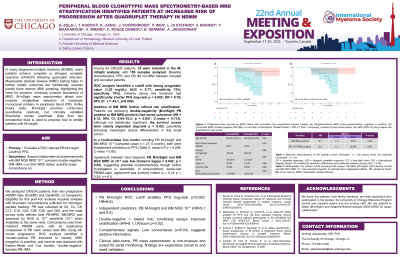
Among 64 CR/sCR patients, 33 were included in the M-inSight analysis. Baseline characteristics, PFS, and OS did not differ between included and excluded patients.
ROC analysis identified a cutoff with strong prognostic value (AUC = 0.77; sensitivity 75%; specificity 76%). Patients above this threshold had significantly shorter PFS (p = 0.002; HR = 8.76; 95% CI: 1.7–45.1).
Addition of BM MRD further refined risk stratification. Patients not achieving double-negativity (M-inSight PB positive or BM MRD-positive) had worse outcomes (HR = 8.12; 95% CI: 0.94–70.2; p = 0.057; C-index = 0.713). Although not statistically significant, the survival curves were clearly separated (log-rank p = 0.02), potentially indicating meaningful clinical differentiation in this small cohort.
A ROC-derived M-inSight threshold identifies patients in CR/sCR with increased risk of progression after quadruplet therapy. Integration with BM MRD enhances stratification, supporting the role of PB clonotypic mass spectrometry as a non-invasive, clinically meaningful tool in MRD-guided monitoring.