
Cellular and T cell engager Immunotherapy
Category: Cellular and T cell engager Immunotherapy
Analysis of Patients With Prior BCMA-Targeted Therapy and Those Achieving CR in REALiTAL: A Multi-Country Observational Study of Talquetamab in RRMM Outside of Clinical Trials


K. Martin Kortüm (he/him/his)
Professor
Department of Internal Medicine II, University Hospital of Würzburg
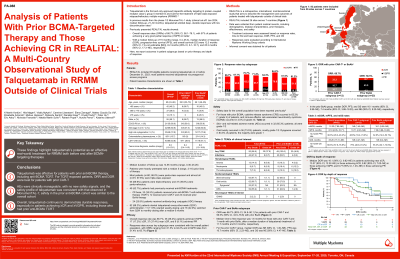
Overall, 93 eligible patients (82 starting Q2W dosing) were included across 26 sites in 7 countries. Patients received a median of 5 prior lines of therapy. With a median follow-up of 15 (0.4–25.3) months, ORR was 66.7% (95% CI, 56.1–76.1), with 57% of patients achieving a very good partial response or better (≥VGPR). Median DOR, PFS, and OS were 12.3 mo (95% CI, 7.9–not estimable; NE), 8.2 mo (95% CI, 6.1–10.7), and 25.3 mo (95% CI, 17.3–NE), respectively. In those achieving CR (n=17 [18.3%]), median DOR, PFS, and OS were NE (95% CI, 8.84–NE), NE (10.71–NE), and NE (NE–NE), respectively. Among patients with prior anti-BCMA TCRT (n=33 [35.5%]), 12 received prior CAR-T and 23 received prior bispecific antibody (BsAb) therapy. For prior CAR-T and prior BsAb groups, ORRs were 66.7% (95% CI, 34.9–90.1) and 56.5% (95% CI, 34.5–76.8), with a median TTFR of 1.6 and 1 mo after a median duration of Tal treatment of 11.7 and 6.3 mo, respectively. For the prior CAR-T group, median DOR was NE (95% CI, 1.45–NE), PFS was 10.7 mo (95% CI, 2.23–NE), and OS was NE (95% CI, 4.47–NE). In the prior BsAb group, median DOR, PFS, and OS were 16.1 mo (95% CI, 5.95–NE), 7.4 mo (95% CI, 3.88–18.20), and NE (95% CI, 9.20–NE). Treatment-emergent adverse events occurred in 98.9% of patients and were mostly grade 1/2. Cytokine release syndrome and immune effector cell–associated neurotoxicity syndrome occurred in 55.9% (gr 3, 1.1%) and 2.2% (0 gr 3) of patients, respectively. Skin/nail and oral toxicities occurred in 67.7% (gr 3/4, 1.1%) and 66.7% (gr 3/4, 1.1%) of patients, respectively. Dysgeusia occurred in 56.9% of patients.
Conclusions:
REALiTAL showed similar efficacy and a manageable safety profile to that observed in MonumenTAL-1. Tal demonstrated durable responses, especially in patients achieving CR, including those who had prior anti-BCMA TCRT, highlighting Tal’s potential as an effective real-world treatment for RRMM.