
Cellular and T cell engager Immunotherapy
Category: Cellular and T cell engager Immunotherapy
Safety, Efficacy and Health After Teclistamab (SEHAT Study) in patients with Relapsed and Refractory Multiple Myeloma; A Multicentric Real World Indian Experience


Reshma Goel, Final MBBS Student (she/her/hers)
Student
Armed Forces Medical College
Teclistamab is a bispecific antibody targeting B-cell maturation antigen (BCMA), with established efficacy in relapsed and refractory multiple myeloma (RRMM). Introduced in India in September 2023, its real-world performance in Indian patients remains largely unexplored. Given the distinct differences from Western populations, such as socioeconomic disparities, higher infection burden, and variations in healthcare infrastructure, gathering real-world evidence in this context is crucial. This study aims to evaluate the safety, efficacy, and clinical outcomes of teclistamab in Indian RRMM patients.
Methods:
This ongoing ambi-spective cohort study includes 32 patients with RRMM who received teclistamab across eight centers in India between Sep 2023 and May 2025. Data were collected using a standardized questionnaire covering demographic details, prior therapies, teclistamab administration and dosing patterns, treatment response, pre-treatment evaluations, infection-related events, use of intravenous immunoglobulin (IvIg), adverse events, and survival outcomes. The collected data were analyzed using statistical software to assess clinical outcomes and identify relevant trends.
Results:
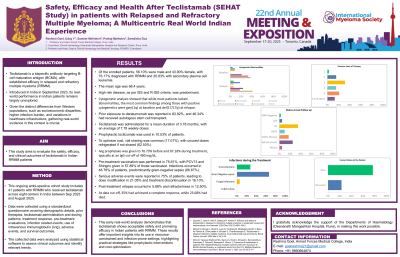
Of the enrolled patients, 56.25% were male and 43.75% female, with 76.19% diagnosed with RRMM and 23.81% with secondary plasma cell leukemia. The mean age was 66.4 years. High-risk disease, as per ISS and R-ISS criteria, was predominant. Cytogenetic analysis showed that while most patients lacked abnormalities, the most common findings among those with positive cytogenetics were gain(1q) at baseline and del(17/17p) at relapse. Prior exposure to daratumumab was reported in 78.12%, and 46.88% had received autologous stem cell transplant. Most had received three (37.04%) or five (25.93%) prior lines of therapy.
Teclistamab was administered for a mean duration of 3.78 months, with an average of 7.78 weekly doses. Prophylactic tocilizumab was used in 96.43% of patients. To optimize cost, vial sharing was common (81.25%), with unused doses refrigerated if not shared (72.42%). IvIg prophylaxis was given to 65.62% before and 84.38% during treatment, typically at an IgG cut-off of 400 mg/dL. Pre-treatment vaccination was performed in 69.23%, with PCV13 and Shingrix given in 94.44% of those vaccinated.
Infections occurred in 40.62% of patients, predominantly gram-negative sepsis (72.73%). Serious adverse events were reported in 73.33% of patients, leading to dose modification in 50% and treatment discontinuation in 14.29%. Post-treatment relapse occurred in 6.90% and refractoriness in 4.35%. At data cut-off, 42.86% had achieved a complete response, while 16.13% had died.
Conclusions:
This early real-world analysis demonstrates that teclistamab shows acceptable safety and promising efficacy in Indian patients with RRMM. These results offer important insights into its use in resource-constrained and infection-prone settings, highlighting practical strategies like prophylactic interventions and cost optimization.